Flagship construction AI case study / 01
AnalyzTech
A production AI system connecting construction drawings, technical documents, computer vision and agent-assisted verification.
Construction document intelligence · Computer vision · Operational software
Historical work led by Hugo Sequier before State Method · Client: BTP Consultants
- Client
- BTP Consultants
- Delivery
- R&D → MVP → Production
- Team
- Solo developer
- Role
- End-to-end AI Engineer & Data Scientist
Case overview
Problem and system
- Problem
- Manual review covered documents of more than 40 pages and plan-based checks.
- System
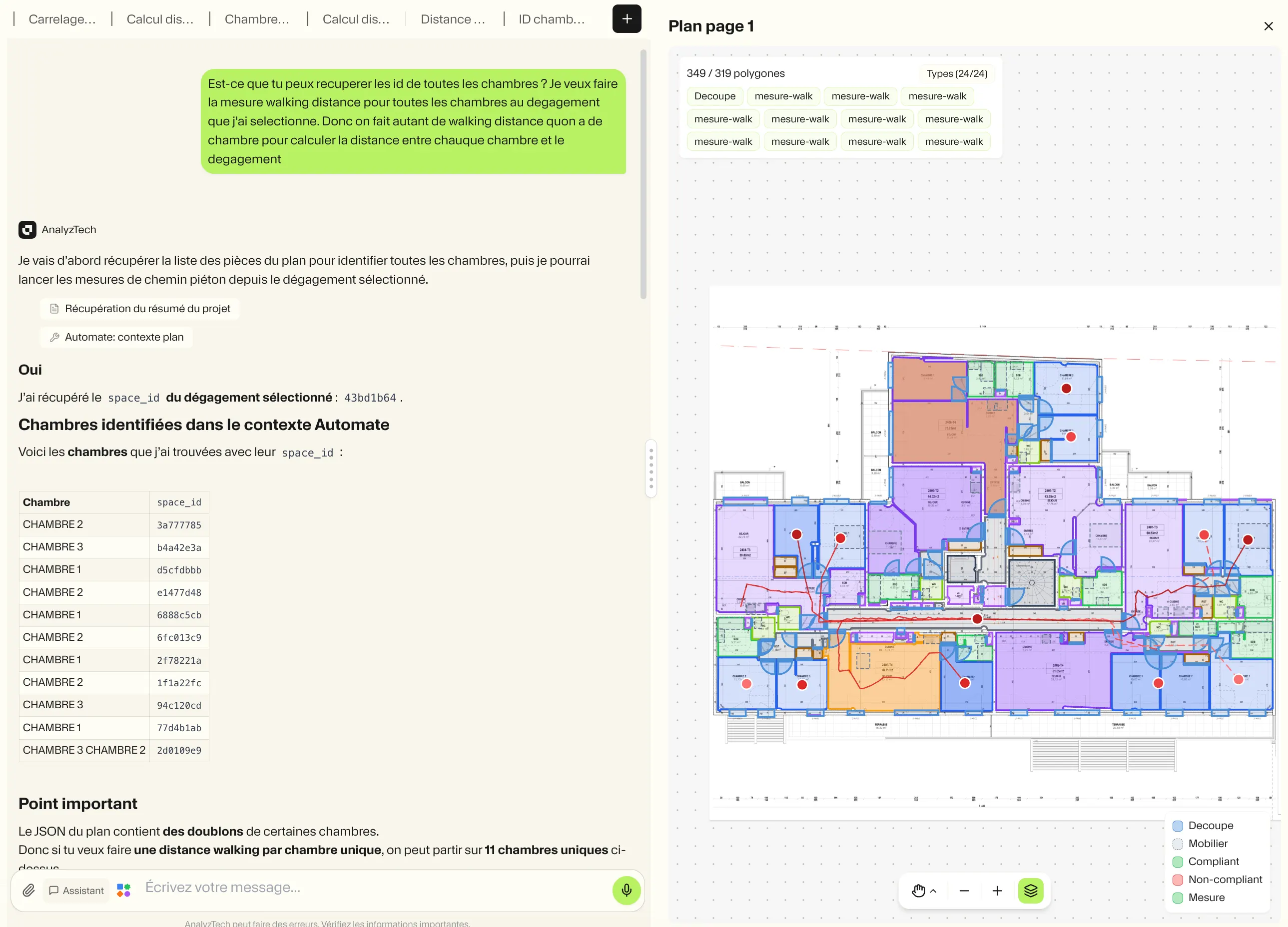
- An R&D-to-production platform combined backend APIs, OCR and computer vision pipelines, polygon visualization, verification skills and AWS deployment. Hugo delivered the work as a solo developer.
Evidence / linked source
Source-reported result
- Time saved on verification workflows
- 80%
- Productivity gain
- +50%
- Classification precision
- 99%
- Room-mask precision
- 96%
The canonical source reports 80% time saved on verification workflows, a 50% productivity gain, 99% classification precision and 96% room-mask precision.
Detailed baselines and calculation methods are not public. This result belongs only to the historical project context.
Canonical AnalyzTech case study ↗Production architecture
From construction PDF to agent-assisted verification.
This architecture and stack are reproduced from the canonical project source. They describe implemented historical work, not a generic capability diagram.
- 01Receive the construction plan PDF and project context.
- 02Use Kreo to detect walls and doors.
- 03Use YOLO to detect furniture and open doors.
- 04Extract rooms and their geometric relationships.
- 05Use a vision-language model to classify rooms.
- 06Post-process geometry, classifications and project metadata.
- 07Route the structured context to AI-agent verification skills.
- 08Expose plan polygons and verification actions through the review interface.
- 09Run the production APIs and model infrastructure on AWS.
Verified stack and integrations
Application and data
- Python
- FastAPI
- PostgreSQL
- Frontend plan visualization
Document and vision AI
- OCR
- YOLO
- Vision-language models
- Room-mask extraction
Geometry and construction processing
- Kreo integration
- Shapely
- Polygon post-processing
- Verification skills
Production infrastructure
- AWS Lambda
- AWS SageMaker
- AWS ECS
- AWS ECR
- AWS ELB
State Method relevance
Boundary, authority and review.
- System boundary
- This public summary covers processing through polygon visualization and the verification interface, including the backend and deployment named in the source. It does not define or make claims about a wider client workflow.
- Human / control relevance
- Interpretation sits beside structured geometry, application state and a verification interface. The model output is therefore described as one part of operational software, not as a standalone decision.
Do not generalize
Context limits
- 01These results belong to the named historical project context.
- 02Detailed baselines and calculation methods are not public.
- 03The client did not contract with State Method, and this page does not imply endorsement of State Method.
- 04The result does not transfer to a different organization, dataset or workflow.